
Active Measures Begins
Measuring the Myth of “Self-Financing” Tax Cuts

Why Measurement Matters
This first installment illustrates why Active Measures — with the emphasis on measuring — is not just useful, but possibly even essential right now. If we hope to confront the forces at work around us, we need more than knee-jerk positions; we need to measure, to quantify, and “face the facts”. This Substack is dedicated to that process: identifying the issues, exposing the threats to democracy and society, and equipping readers to take action.
Citizens who believe that Truth defeats dark forces need more than courage — they need arrows in their quiver: data, evidence, and analysis. Measurement forges those arrows. And in the case of today’s topic — the myth that tax cuts pay for themselves — the evidence, when measured, cuts through the illusion and brings the truth into focus:
Recently, US congressmen and -women claimed that the Big Budget Bill’s tax cuts will stimulate the economy such that tax revenues actually rise. (1) But what economics — and experience — teaches us is that tax cuts never even pay for themselves, much less increase tax revenue.
Why not? There are several reasons:
First, taxpayers save much of the tax cut, especially the wealthier. (As a side note, the BBB graded the cuts to favor the wealthy.) Second, whatever growth effects tax cuts do have tend to diminish over time. Third, if the cuts increase federal deficits, that crowds out private and public investment, because capital flows into government debt instead of funding businesses or infrastructure. And fourth, especially because top earners save more of their windfall, the so-called “multiplier” effect — where one person’s spending becomes another’s income — hardly gets rolling.
For these and other reasons, only about 15–40% of the lost revenue is ever recouped through economic growth. For just one example, modeling by the Urban Institute/Brookings found U.S. tax cuts recover only about 20–30% of their lost revenue in the long term — sometimes even less.
Let’s pause to consider the one model that has been evoked often in this trickle-down crusade: the Laffer curve. This theory holds that tax rates that are too high discourage work and investment so much that lowering them actually increases revenue — because the tax base grows. In theory, at some point on the curve, tax cuts could pay for themselves. Even supposing the graph is sound (a big assumption), we still must consider that where we actually sit on that curve matters. Scholars have repeatedly found that U.S. tax rates are already well below the “tipping point” (around 50%) — meaning further cuts reduce revenue, not raise it.
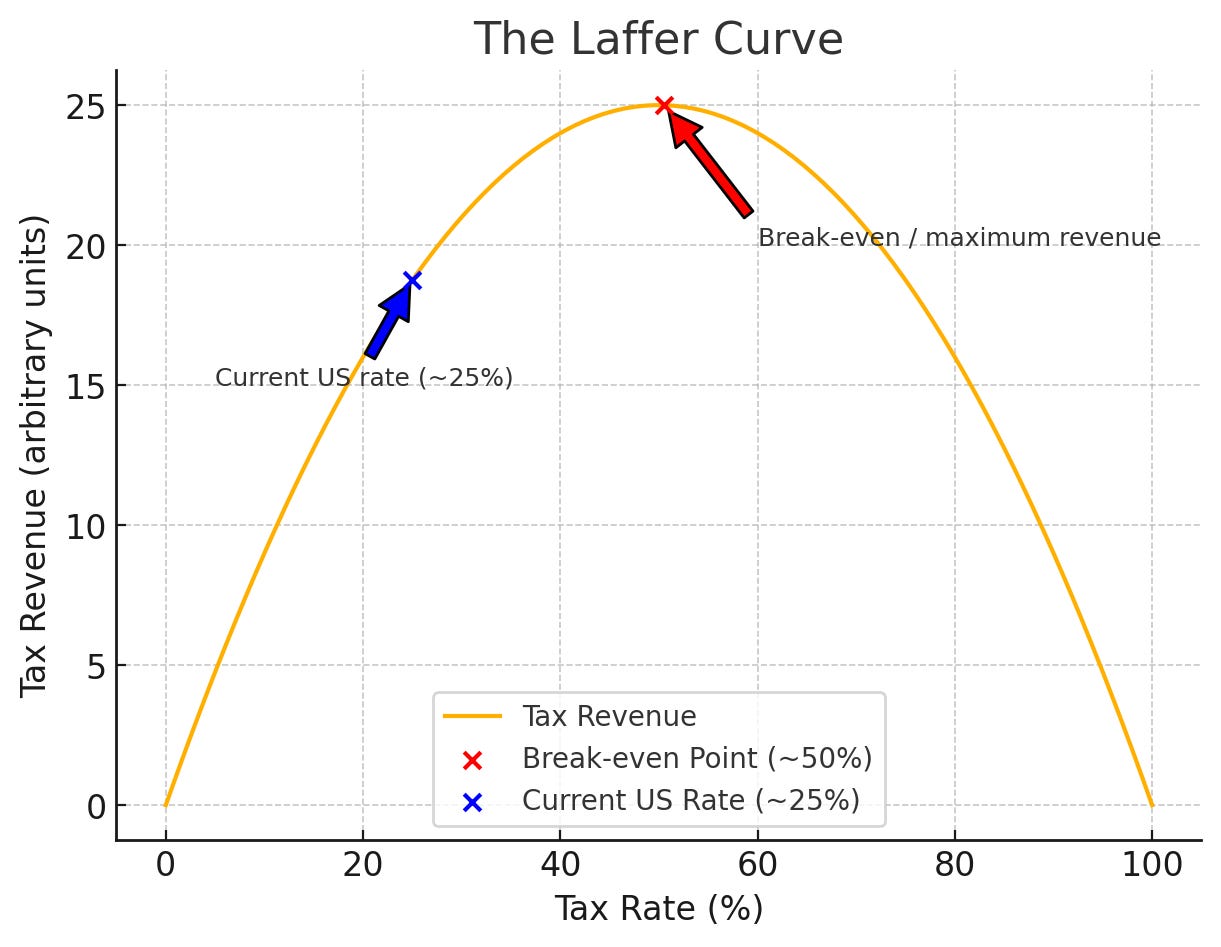
Lest anyone dismiss studies from the Urban Institute as “detached” or just “theory”, we also have evidence from the real world:
>The Bush (Jr.) tax cuts of 2001 and 2003 recouped only 15–35% of lost revenue, according to the Congressional Research Service.
>And the Congressional Budget Office (CBO) and Joint Committee on Taxation (JCT) estimate that only about 25–30% of the 2017 Tax Cuts and Jobs Act will be offset by growth.
>The Reagan tax cuts of the early 1980s introduced the era of ballooning deficits.
We all want a stronger economy, but wishful thinking is not a plan. Tax cuts don’t pay for themselves — and it’s time we started confronting that reality head-on.
This is what Active Measures is about: measuring what’s real, forging arrows of truth, and striking with something way stronger than partisanship: math.
I trust the Laffer curve. I seen it at work in my business for over 33 years. If you tax too high the higher tax payers find legal ways to not pay. Now, politicians can’t cut taxes and then continue to spend. That is a Republican problem.
Now, while it is true the wealthy may save the tax cut savings. But, in my 33 years of work they spend money that helps the economy. Better cars, better homes, home improvements, second homes, better colleges. Not to mention starting businesses and creating jobs.